Tuesday, 13 May 2008

Rob Mulholland - Sculpture for Scotland

Rob Mulholland has been exhibiting successfully at Artery Gallery with his metal work for nearly three years. The vibrancy, and craftsmanship of his bowls in particular proving a real hit all year round.

He has recently had eight sculptures commissioned by Scottish Enterprise and Forestry Commission Scotland. The brief was to create representations of animals and birds as part of the natural food chain in the forest. The brief allowed for a certain degree of abstraction of the forms as long as they were still recognisable to the public.

Rob says, "My proposal aimed to develop each sculpture individually utilising different materials and methodology. I felt that it was also important to vary the scale and placing of each sculpture to add variety and interest to the trail."

The whole project has taken four months from the planning stage in January 2008 to the installation of the work and final completion at the end of April 2008.

The first of Rob's sculptures to be installed at the trail is the giant 'Osprey'. He explains, "With this sculpture I wanted to explore the form and movement of the bird. As the ideas developed I thought that it would be an interesting to construct the bird out of the type of small twigs that they collect to build their nests. I was keen to switch the materials and decided to use 6 and 8mm steel rode. The freedom offered by welding these small interlocking pieces allowed me to create varied masses within the form of the sculpture which makes the shape change as one moves around the Osprey. From certain angles the form becomes more abstracted."
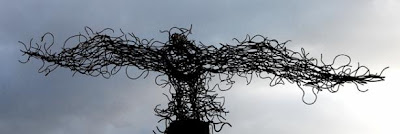

Rob Mulholland was interviewed on BBC's 'Landward' programme which aired in May, by Nick Nairn on the installation of the Osprey sculpture, the first of eight for the new Loch Ard cycle trail in the Trossachs.

Rob's work can be purchased online at http://www.arteryuk.com/artists/Mulholland,Rob/

Friday, 2 May 2008

Buying Handmade Over The Mass Produced


The rapid rise of the large chain store culture and global manufacturing has left us furnishing and dressing alike. It’s almost like the consumer is being told what to buy because the shelves are full with goods of all the same design and colour as the next shop. Our ties to the local and human sources of our goods have been lost.

Mass production has always been with us, generally speaking as a way of ensuring quality. But this has not always been the case. Taking printing as an example, the earliest printers initially showed perfectionist tendencies, probably because the hand operated press machine and letter stamps were all created by hand to do the job. In the late sixteenth century, printing began to turn into an industry. It was largely considered at the time that these industrial printing practices should never allow commercial considerations to lower the typographical standard of books and printed documents.


But things inevitably went the other way in the nineteenth century after the invention of the steam press. The necessity to produce cheaper books and newspapers meant that standards fell, and mass production began to gain its poor reputation. It was during the nineteenth century that artist and writer William Morris began to worry that mechanised production was taking away opportunities for individual creativity, and to almost dehumanise people's working and social lives. Morris planned to counter these apparent problems with a revival of handicrafts. Numerous craft based associations, guilds and communities were founded, and the idea of something being hand made all of a sudden became rather fashionable. The customers for these hand made products were of course the better off for this change.


A memorial to what became known as the ‘Arts and Crafts Movement’ is now preserved at Standen in Sussex, a grand house decorated by William Morris himself.


It is often considered that buying a handmade gift involves that little bit more consideration and thought. You buy into something that is a unique, one off creation, and in today’s world that is still consumed by mass produced goods, it makes it all the more satisfying.


A handmade craft, whether it’s in the form of a painting, clock, pottery or jewellery, will be chosen for its pure individuality and will instantly reflect the personality of the purchaser.


If it has been purchased for the purpose of a gift, the buyer may well feel the satisfaction of supporting an artist or craftsperson as well as being confident of giving something of quality and uniqueness. Likewise, the recipient of the handmade gift receives something that is one-of-a-kind, and made with care and attention. It is the result of skill and craftsmanship that is clearly absent in the world of large-scale manufacturing.


If you are looking to buy, whether for yourself or someone else, buying handmade can help us reconnect with ourselves and therefore certainly better for both maker and buyer.


Above: Allan Craig Arts and Craft style copper clocks, mirrors and sconces
Top of post: Kerry Whittle, John McPhail and Tim Fowler


Digg!

www.arteryuk.com

Wednesday, 16 April 2008

Elvis Presley - 'Flaming Star' to Flaming Art

Elvis Presley still receives much attention and admiration, not only for his catalogue of work but also for his whole image as a single package. His music still lives on today, along with this most iconic image he had, especially in the Pop art screenprints of Andy Warhol which have become some of the most recognised works by the artist.

The image of Elvis Presley is unmistakable, and Scottish abstract artist Derek Collins has incorporated it into one of his own renowned 'Flaming Art' paintings.

Derek has been creating his unique style of abstract art for many years, constantly developing and fine tuning his techniques. Derek creates these stunning pieces by pouring carefully selected special resins, powders, pigments and liquids on to canvas. His creations really come to life though when the main ingredient is added, fire!

He says, “I love the way other paints and lacquers affect one another, if one paint is not compatible the other paint does not want to touch it so it moves away or breaks the weaker paint and forms another effect. When you then add the thinners of different paints, another reaction takes place, too much thinner will make it flow out but set it alight and it will evaporate the thinners and seal off the paints.”

As well as these paints and lacquers, Derek has used all kinds of extra materials in his art, from sand and shards of glass to leaves and moss. He has even been asked on many occasions, by special request, to incorporate ashes from departed loved ones. Being an incredibly sensitive matter, it’s something Derek took on with great pride and care.

He says “Quite often people are left with loved ones ashes and are not quite sure what to do with them. Using the ashes in a painting is a great way to commemorate a life, and creates something close and personal that can be kept in the home and more importantly in the family for years and years to come.”

We have yet to confirm with Derek to find out if he used any of Elvis' ashes in this particular piece!!

Digg!
www.arteryuk.com

Tuesday, 15 April 2008

Unique Handmade Jewellery

Most of the jewellery you'll find on the high street has been mass produced, but at Artery Gallery, all the jewellers exhibiting design and create their own jewellery by hand.

Using pure Silver together with Semi-precious stones, pearls or Swarovski crystals, sourced from all over the world, the top quality artists you find at Artery Gallery create truly unique pieces of beautifully handcrafted contemporary jewellery.

Buying handmade jewellery means that you have a unique or limited edition item, not to be seen on anyone else. Choose the jewellery you like and make a statement that reflects your personality and style!

We have Scottish artists such as Christine Forsyth creating wonderfully designed contemporary silver jewellery and Angela Learoyd using a vast array of unique stones and beads. Together with Angel Neal, famed for her wedding jewellery and often featured in many high class magazines.

Jewellers from across the UK can also be found at Artery Gallery, with the lampworking style of Rachel Dawes. Lampworking is the process of making glass beads using rods of different coloured glass and an extremely hot specialist torch. Decorations on the individual beads can be added with different coloured glass to create elaborate and complex designs.

Birmingham based Lora Leedham’s jewellery has a very feminine, fresh and romantic style to it and the designs portray an emphasis on texture. Inspiration is taken from a hobby of photographing nature and looking at its textures and forms. The jewellery, as featured in magazines, has also made TV appearances, one of which was worn by Camilla, Duchess of Cornwall.

One of Artery Gallery’s more renowned jewellers is Brazilian Patricia Gurgel-Segrillo. Following on from continued success exhibiting with Artery Gallery, her hand woven silver and gold jewellery has hit the spotlight in recent times thanks to one of her more famous collectors, British actor Orlando Bloom wearing her woven bands in publicity shots. Subsequently, links with the Orlando Bloom Files website have been set up exclusively with www.arteryuk.com to help promote her highly stylish jewellery, with Artery Gallery acting as distributors to Scotland for her work.

Buying and wearing handcrafted jewellery is a personal and special experience. All our jewellers are specifically chosen because of their innovative design, their high quality and real value for money.

Whether you are looking for earrings, necklaces or rings, with the jewellers we have assembled at Artery Gallery, we are sure that you will find the ideal romantic gift or a truly inspirational jewellery piece to enhance your image.

Digg!
http://www.arteryuk.com/

Friday, 11 April 2008

Under the Influence of the Scottish Landscape

Exhibiting at Artery Gallery in Crieff and St Andrews with his new work is internationally selling artist Colin Carruthers Due to the high success Colin has had in exhibiting his work previously through Artery Gallery, he has given the gallery exclusive selling rights, now allowing them to be the only gallery in Scotland to show his works.

Jason Michaelson of Artery Gallery says “We feel this is a bit of a coup for us, being a Scottish contemporary art gallery and securing unique selling rights to the works of a successful artist. We like to work with our artists and try to help them progress. In his time exhibiting with us, we have seen a fantastic development in Colin’s work and this has been reflected in his success”.


Originally from Northern Ireland, Colin says, “I regularly travel to Scotland, where I find the high drama of the Scottish Coast, a constant source of influence for my paintings. There's a challenge involved in my work. With every canvas I attempt, I am searching for something. Beyond simply looking at my paintings and gaining an aesthetic pleasure, I do think it's important that they offer up space for thought"


The strengths of his canvases lie in their versatile response to nature as he grapples with the relationship between memory, place and emotion. His work challenges our assumptions of landscape and returns us to a new sense of engagement, both spiritual and practical, with our surroundings.


http://www.arteryuk.com/

Thursday, 3 April 2008

Nostalgia and the Now

Artery Gallery welcomes new works from painter Scott Carruthers, exhibiting in St Andrews for the second time.

His paintings are largely inspired by a mix from the nostalgia of his childhood in the 70's and early 80's, along with watching his two young kids grow up. Not necessarily making any comparisons, but being reminded of his early years and how their life today differs in these modern times, yet in a way mirror his own childhood.

Scott explains his thoughts behind one of his works, "Our children seem to be growing up quicker all the time. If you don't believe it, think back to what you were doing and what you had at different stages of your childhood. I imagine it differs greatly.


Kids seem to get to a point where there just want to be older. Yet it will happen all too quickly and before they know it they will be forever chasing their youth.


He adds, "I don’t want my kids to turn around in 30 years and say to me “I was so concerned about growing up faster; I wish there was a way I could of slowed it down.”


I’m sure there are ways of helping that. It’s important that parents understand the need for an orderly progression through childhood. In the past there were important cultural “markers” that determined the ages at which certain behaviours and belongings were appropriate. Those markers seem to have disappeared, or they’ve certainly been moved downward."


"At best, you’re only a kid for about 12 years, with another 70 taken up by adulthood. Surely someone in the beginning didn’t think that ratio through properly!"


Scott's new works, including "Slow this Bird Down" and "Street Children", are exhibiting at our St Andrews gallery now.


www.arteryuk.com

Friday, 28 March 2008

Creative Scotland Awards

The Scottish Arts Council Creative Scotland Awards are amongst the richest arts awards in Europe. They reward, honour and celebrate established and leading artists in Scotland and raise the profile of the arts and their contribution to Scotland.

To learn more about these artists and to discover the range and diversity of these amazing lottery-funded projects, visit the Creative Scotland website at http://www.creativescotland.org.uk/


http://www.arteryuk.com/

Clouds, Mighty Without Movement

Renowned Italian artist Alberto Bertoldi’s original oil paintings are fascinating and beautiful since his subject, the sky and the clouds, is equally fascinating and beautiful. Alberto explains, “I was flying on a plane, and as it broke through the clouds, I experienced a most incredible moment. While I was looking out of the window, the plane seemed to hang between the sea and infinity, between sky and earth. With extreme emotion I watched what humans three thousand years ago could only imagine.”

He adds, “When I reached my destination, I dared to watch the horizon again, now from the tiny beach of St Vincente, and I realised for the first time the clouds, mighty, without movement or speed, act like curtains. I witnessed how this curtain of clouds hid the endless universe and its sound.”

Alberto Bertoldi was born in Torino in 1955, and now lives and works in Piacenza, northern Italy. He has prepared over 30 personal exhibitions across his homeland together with having beautifully illustrated books published about himself and his work. Now for the first time, he has been introduced to the UK through Artery Gallery, based in both St Andrews and Crieff.

Alberto started painting from an early age and besides a brief spell at the Academy of Arts in Brera, is largely considered a self taught artist. He held his first exhibition at the age of 18 though shortly after suspended his painting for a long period of time. Upon reaching his early 30’s, Alberto returned to his work, in complete solitude, with intense work and studying various subjects. Now, differently to his earlier subjects, he looked towards the ancient artists of Northern Europe that were closer to his propensity for landscape painting and, in general, for the aesthetic of sublime.

Alberto's cloud paintings have proved very popular with many pilots becoming collectors of his work. One pilot from RAF Leuchars in Fife recently purchased a painting by Alberto, and stated "It's like looking out of my office window!”


http://www.arteryuk.com/

Thursday, 27 March 2008

Lora Leedham - At The "Venetian Heart" of British Fashion

Lora Leedham’s silver, Venetian glass and gemstone jewellery is capturing the British fashion world!

Lora Leedham is an independent jewellery designer from the Midlands. She had initially intended to be an interior designer, but found her passion for jewellery design while studying design at university.

After setting up ‘Jewellery by Lora Leedham’ in 2006 she has made an impact on the British fashion world, exhibiting in London Fashion week, designing jewellery for stars, celebrities and even royalty – she created jewellery for Camilla Parker Bowles, which Camilla wore on live television. She has worked with different fashion designers, in international fashion houses, created jewellery for charity auctions and was featured in a March issue of ‘Grazia’ magazine.

Her current jewellery designs feature Venetian glass hearts in rainbow colours, captured in handmade silver wire cages. She also creates gemstone studded ‘willow’ rings, using only ethically sourced gems such as tourmaline.

Artery Gallery has a selection of jewellery from different ranges in her collection.


http://www.arteryuk.com/

Tuesday, 18 March 2008

The Surreal Deal - Andrew Baines

New works by Andrew Baines are now on exhibition at Artery Gallery in St Andrews.

Andrew has exhibited extensively in Switzerland, the US and Canada as well as around Australia and has proved equally collectable in Scotland, since being introduced by Artery Gallery three years ago

One time illustrator and sign-writer, Andrew Baines has risen in recent years to become one of Australia’s top contemporary artists. In the last four years alone, he has been a finalist in no less than twelve competitions, two of which have been for the Australian National Portrait award.

It has been as a figurative painter that his reputation has been established. With a strong resemblance to the work of Belgian surrealist Rene Magritte, the majority of Andrew’s work depict suited businessmen, not necessarily floating in the sky, but lined up along the shallows of a golden beach, reminiscent of the beaches near to his hometown of Grange, South Australia.

With other huge influences being Andy Warhol, David Hockney and Prohart, the inspiration behind Andrew’s paintings are more direct and pivotal to his own experiences and personal decision to become a painter.

"When I was 14, my parents took me back to England to visit the relatives," says Baines, who had emigrated from Colchester when he was just one year old. "One morning we caught the Underground. I went down onto the platform and I was greeted by a sea of formally dressed, bowler-hatted men, holding their umbrellas and briefcases. It just looked so incredible, because they were all clones and they all looked lifeless ... waiting for their train to come in. That stayed in my subconscious for years and years."

When Baines got his first job at 17 at a department store, these images resurfaced. He adds, "I'd be on the bus with all these commuters and think to myself that this is exactly the same as the bowler-hat men – but much more Australian, more casual. I used to think their lives were already spelled out for them. I thought to myself, 'I don't want to be like this'."

His early surrealism was largely ignored. Since he lived by the beach and had always done so, it was suggested to him that he began interpreting the environment closest to him.

He says he had avoided painting the beach because he wanted to be different. The beach was too obvious. But the beach was a hit with the art market and Baines' exhibitions were sell-outs.

With his paintings taking of commercially, Andrew mixed this style with his original vision. Now his beach shallows and rolling hills are populated by circus performers, herds of cows and wooden chairs! "They've still got that nice aesthetic mood but then you've got my underlying, self-conscious feelings on life coming through," he says. A post-modern landscape.

Surrealism has dwelt in his mind's eye throughout his painting years and it is a genre to which he returns, rather than begins. With this amount of success as an artist, Andrew Baines has become the real deal.

Digg!

www.arteryuk.com

Friday, 14 March 2008

Renowned Sculptor Exhibits in St Andrews

Heralded by many in the art world as the next Henry Moore, Alexandros Arabatzoglou’s sculptures have been sold to private collectors all over the world, and demand for his work has been such that he has not exhibited in a gallery for nearly nine years, despite offers from some of the worlds most prestigious galleries. However, after striking up a relationship with Artery Gallery, Alexandros decided to end his gallery exile by exhibiting one of his hand carved sculptures in their St Andrews branch.

Born in Heraklion, Crete in 1970, Alexandros came from an artistic family and has therefore been involved in art since a very early age, beginning with designing and creating his own unique jewellery. It was during this period that he was chosen as “Finest Modern Greek Artist” by the BBC. Later he discovered his passion for harder materials, and started to work with bronze and different kinds of stone, clay and glass. After many years of work and experimentation forging these materials together, Alexandros invented his own style of modern sculpture – a unique ability to craft bronze and stone into a single organic form. Every piece is a one-off and can take up to four months to create. There are no moulds or copies and each comes with individual certification from the Greek government.

"The Golden Fish” sculpture was commissioned especially for Artery Gallery to be displayed at their St Andrews branch and is seen as a coup for the Scottish gallery. Jason of Artery explains “After meeting with Alexandros in Crete last year, I was amazed at his drive, passion and enthusiasm for his work and his art. For him, creating his sculpture is like breaking down to the bare bones of his inner soul, using his hands to carve into the stone and creating an extension of himself within each individual sculpture”. He adds “Here at Artery Gallery, we are always looking to expand on the superb catalogue of talent we exhibit, and inviting Alexandros to join us, knowing of the interest he has gained, is exciting for the gallery, for St Andrews, and for world art exhibited in Scotland”.

Artery Gallery at 43 South Street, St Andrews (01334 478221)

Digg!


http://www.arteryuk.com/

Wednesday, 12 March 2008

National Galleries of Scotland Art Competition for Schools 2008

The annual National Galleries of Scotland Art Competition for Schools 2008 is now open for entries. Please send your entries to Linda McClelland, National Gallery of Scotland, The Mound, Edinburgh, EH2 2EL.

This year there are six categories for entry, each with a different theme:

Category A Nursery Schools (Theme – Birds)
Category B Primary 1-3 (Theme – Can you see the music?)
Category C Primary 4-7 (Theme – Sit in Splendour)
Category D S1 and S2 (Theme – Art to Wear)
Category E Special Education Schools (Theme – Come Closer)
Category F Group Work (Theme – selected from any of the above)

Pupils are asked to view selected works from the Online Collection of the National Galleries of Scotland and to make their own personal response on paper. The closing date is Friday 9th May 2008.

An awards ceremony will be held at the National Gallery of Scotland in June 2008. Prizes include digital cameras for schools, art materials, art workshops and gallery visits.

If you have any questions regarding this year's competition telephone 0131 624 6534 or email competition@nationalgalleries.org

Friday, 7 March 2008

Spring Exhibition at Artery Gallery


January and February are often grey and miserable but thankfully we are now into March, and Spring will soon be on the way.

Here at Artery Gallery we thought we would celebrate by bringing in some Springtime Colour!

We are proud to introduce two new artists whose work is awash with colour, character and sheer vibrancy.

Lancashire born, self-taught water-colourist Kelvin Burgoyne and former restoration architect John Wetten-Brown from Glasgow.

Recent art graduate John Wetten-Brown has gone from restoring Scotland's Historic monuments, to painting some of Scotland's most interesting treasures. His subjects range from historic fishing villages like Crail and Pittenweem, to the landscapes of Skye, Mull and Sutherland with great sweeps of mountain, moorland and sky.

For many years Kelvin Burgoyne searched for the balance between English landscape and Mediterranean colour, an almost impossible arrangement. However, whilst drawing over moorland in August 1999 on a fabulously hot summer day, he experienced what most outdoor activists encounter. A sudden blackness, stillness and a chill brought on by a heavy summer storm. At its deepest, inexplicably, he saw the countryside bathed in vivid colour and the buildings almost white, mentally capturing the moment he has continued with this vision and works exclusively in the search for watercolour splendour.

Thursday, 14 February 2008

Scotlands Bold Landscape


Scottish artist Martin Devine has launched his latest exhibition of work at Artery Gallery in both St Andrews and Crieff.


Martin, of Linlithgow, Employs colour theory, varying the use of tone and differing brush strokes to present a contemporary image of the Scottish landscape, aiming to change the perception of the landscape seen by the viewer.


Martin explains, “I originally discovered an artistic ability in portraiture and wildlife, moving onto landscapes which have now become my recognized field in a distinctive style”.

Inspired by minimalism, spare with detail, encouraging a regard for simplicity, the strengths of his watercolour paintings lie in the boldness of the colours he uses, perfectly outlined with Indian ink.


His paintings have proved a huge success in his short time with Artery Gallery, selling out his previous two exhibitions.

The work of Martin Devine can be viewed online at www.arteryuk.com or by visiting Artery Gallery in St Andrews and Crieff


www.arteryuk.com

Wednesday, 16 January 2008

Mythical Sculpture! - "The Golden Fish" by Alexandros Arabatzoglou


In some cultures a fish can be a potent sign of fertility, signifying abundance, movement and creativity. For example, in Roman mythology a fish can be a symbol of love – fetching Venus to mind – or the power of the waters, mighty Neptune. Fish in baskets – as in meals of plenty, bread and wine, the foods of redemption – and fish in association with an axe as in Assyria and Crete, or perhaps with moon shapes in many of the fishing cultures, all represent blessings and confer magic fertility on the catch or upon the whole community.

In China. Great Mother Kwan-yin was often portrayed as a fish. In India the Goddess Kali was called ‘the fish eyed one’, and in ancient Egypt, Isis was called Great Fish of the Abyss. In Greece. the Greek word ‘delphos’ meant both fish and womb. The word is derived from the oracle at Delphi, who worshipped the original fish goddess Themis.


"Alexandros, is giving everything to get into his sculpture, the same amount of hummanity and seriousness, nobility and experience, acceptance of life, distinction and aristocracy.With absolutely no tricks, no effection, no self conciousness, looking straight ahead, no movemant...but more alive than a real person."

Alexandros Arabazoglou was born in Heraclion, Crete in 1970. He comes from an art family, and from when he was a child, he got involved in the art of jewellery. He was designing and creating unique pieces and he was selected as a fine artist from the BBC channel. Soon he discovered his passion for harder materials, and he started to work with Bronze and different kinds of stones, clay and glass. After many years of work, he had managed to match these materials together, and create his own style in modern art. All his pieces are unique (editions of one). He has taken part in many exibitions all around the world, and many of his sculptures are in private collections.


Visit the Artery Gallery website at :www.arteryuk.com